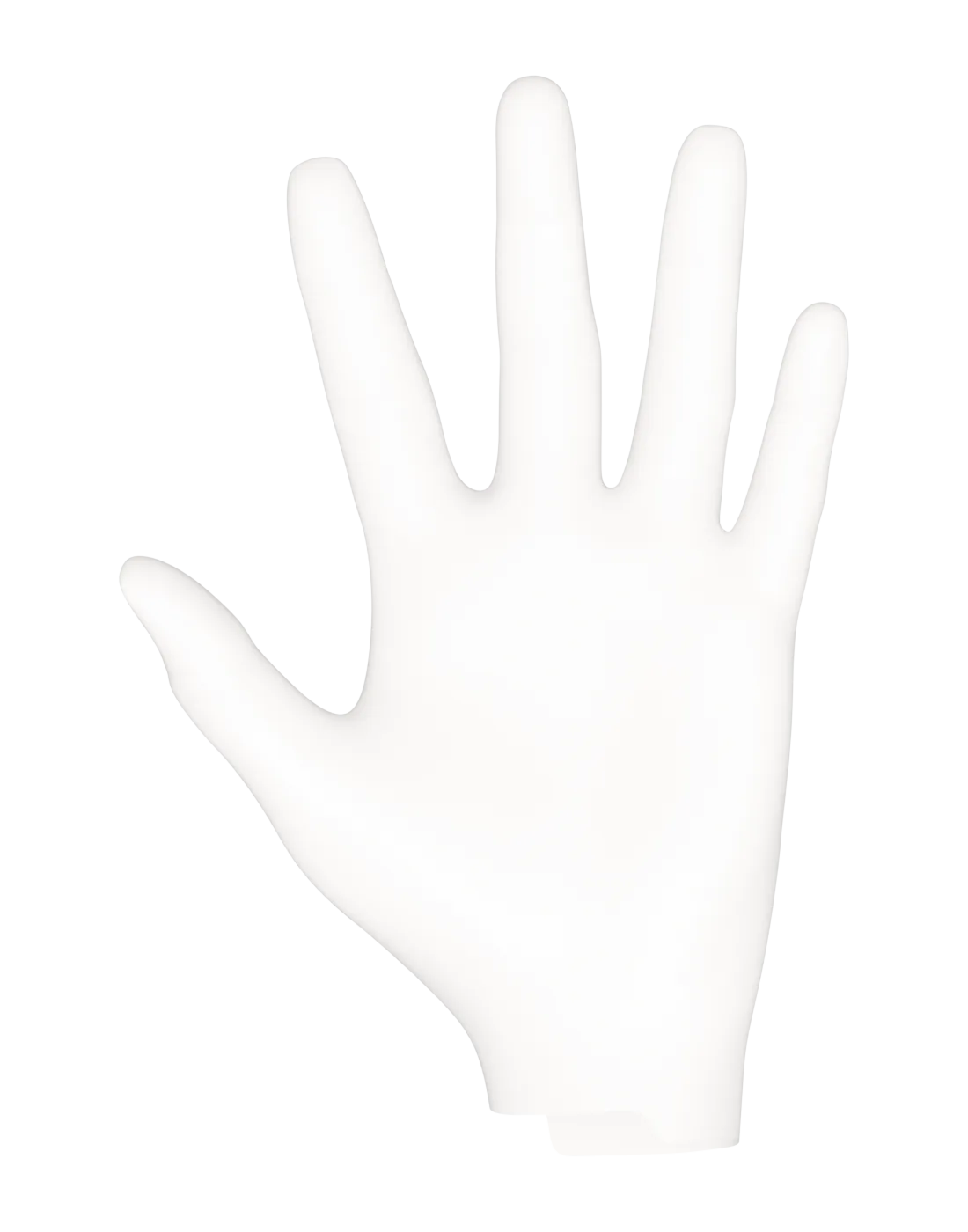
Spine - lumbar, sacrum and coccyx on the left hand · 29 areas · ringed markers are placed differently by different schools
Placement
Location: Along the radial border of the left hand from the base of the first metacarpal down to the wrist crease, with the coccyx at the wrist end.
Longitudinal zone(s): 1 of 5
Side: left hand
Tradition: Ingham (Western)
How other schools place it
Ingham (Western)
Most Ingham-lineage hand charts end the spinal line at the wrist crease, putting lumbar, sacrum and coccyx along the radial border of the carpal area.
Charts differ over how much of the lower spine the hand is taken to carry at all; several stop at the base of the first metacarpal.
Chinese reflexology
Chinese hand charts show the lumbar, sacral and coccygeal areas on the DORSUM of the hand, running along the radial border of the first metacarpal and the wrist rather than on the palmar edge.
So the two lineages disagree over the surface as well as over the extent.
Traditional use
Traditionally worked slowly in both directions as the closing part of a back sequence.
Reflexology is a traditional practice, not an evidence-based medical treatment. Systematic reviews have not shown it to be effective for any medical condition. These maps document what practitioners traditionally use — they are not claims about how the body works.
Care and caution
Conventional practice avoids strong pressure where there is recent back injury, spinal surgery or acute pain, and refers instead. The lumbosacral and coccygeal part of this line is among the areas traditionally avoided in pregnancy; in pregnancy this area is not worked. Do not work over open or infected skin, recent fracture or recent wrist surgery.
Frequently asked questions
Where is the spine - lumbar, sacrum and coccyx reflex area on the hand?+
Along the radial border of the left hand from the base of the first metacarpal down to the wrist crease, with the coccyx at the wrist end.
Which tradition does this placement come from?+
Ingham (Western). Other schools place this area differently; the variants are documented on this page.
Does pressing this area treat the organ it is named after?+
No. Reflexology maps are traditional diagrams, not descriptions of anatomy or physiology. Systematic reviews have not found reflexology to be an effective treatment for any medical condition.
Is there anything to be careful about?+
Conventional practice avoids strong pressure where there is recent back injury, spinal surgery or acute pain, and refers instead. The lumbosacral and coccygeal part of this line is among the areas traditionally avoided in pregnancy; in pregnancy this area is not worked. Do not work over open or infected skin, recent fracture or recent wrist surgery.
Sources
References displayed on this page were recorded with the point dataset.